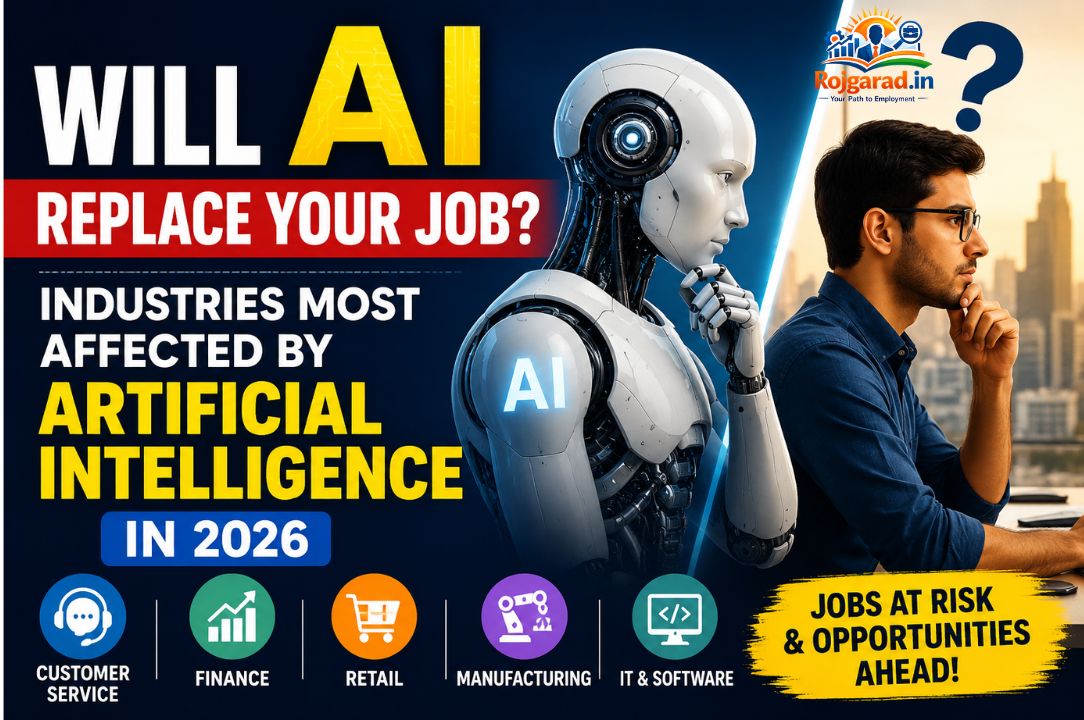
Artificial Intelligence has moved from science fiction into everyday life. Students use AI-powered study tools, businesses automate customer support, hospitals use intelligent systems for diagnosis, and software developers rely on AI coding assistants. As AI technology becomes more powerful in 2026, one question is being asked across schools, colleges, offices, and industries: Will AI replace your job? The answer is more complex than a simple yes or no. AI is replacing certain tasks, transforming many jobs, and creating entirely new career opportunities at the same time. Understanding which industries are most affected and how workers can adapt is becoming one of the most important career decisions of this decade.
| Key Topic | Summary |
|---|---|
| AI and Jobs | AI is changing jobs faster than ever but is not replacing all workers. |
| Most Affected Industries | Customer service, IT, finance, media, retail, and manufacturing face major transformation. |
| Safe Careers | Healthcare, skilled trades, education, creative leadership, and human-centered roles remain relatively secure. |
| New Opportunities | AI trainers, prompt engineers, AI auditors, data specialists, and automation managers are growing. |
| Student Focus | Digital skills, communication, problem-solving, and AI literacy are becoming essential. |
Understanding How AI Replaces Work
When people hear that AI is replacing jobs, they often imagine robots taking over entire professions. In reality, AI usually replaces specific tasks rather than complete occupations. For example, a customer service executive may spend hours answering repetitive questions. AI chatbots can now handle many of these routine inquiries. However, complex complaints, emotional conversations, and relationship management still require human involvement. This means the job changes rather than disappears completely. The same pattern is visible across many industries where repetitive, predictable, and data-driven tasks are increasingly automated while human workers focus on decision-making, creativity, and interpersonal skills.
Why AI Adoption Accelerated in 2026
The rapid growth of generative AI, machine learning, cloud computing, and automation platforms has significantly reduced the cost of implementing AI systems. Companies no longer need massive technology budgets to automate workflows. Small businesses can now access AI tools for customer support, content creation, accounting assistance, recruitment screening, and marketing campaigns. The competitive pressure to improve efficiency and reduce costs has encouraged organizations to integrate AI into daily operations. As a result, employers increasingly expect workers to collaborate with AI tools instead of competing against them.
Industries Most Affected by AI in 2026
Customer Service and Call Centers
The customer service industry has experienced one of the most noticeable AI transformations. Intelligent chatbots, voice assistants, and automated support systems can handle thousands of customer interactions simultaneously. Businesses are using AI to answer common questions, process refunds, schedule appointments, and troubleshoot basic issues. While entry-level support positions may decline, companies still require human agents for complex situations, escalations, sales conversations, and customer relationship management. Workers who learn customer experience management and AI supervision skills are finding new opportunities within the industry.
Information Technology and Software Development
Software development was once considered highly protected from automation, but AI coding assistants have changed the landscape. Modern AI tools can generate code, identify bugs, write documentation, and suggest software solutions within seconds. However, AI cannot independently manage large-scale software architecture, business requirements, cybersecurity strategies, or product innovation. Developers who use AI as a productivity tool are becoming more valuable than those who avoid it. In 2026, the most successful technology professionals are not competing with AI but using it to increase efficiency and solve more complex problems.
Content Creation and Media
Journalism, blogging, advertising, social media management, and digital marketing have seen significant disruption from generative AI. Businesses now use AI to draft articles, create social media captions, generate marketing ideas, and produce visual content. Despite this automation, human creativity remains crucial for storytelling, brand strategy, investigative journalism, and audience engagement. Readers continue to value authentic perspectives, expertise, and emotional connection. As a result, content professionals who combine creativity with AI tools are often outperforming traditional content creators.
Banking and Financial Services
Financial institutions increasingly use AI for fraud detection, loan evaluation, risk analysis, customer support, and investment recommendations. Many repetitive back-office functions have become automated, reducing the demand for certain administrative roles. However, financial planning, wealth management, relationship banking, compliance oversight, and strategic decision-making still require experienced professionals. Employees who understand both finance and AI analytics are becoming highly sought after in the banking sector.
Retail and E-Commerce
Retail businesses now use AI to manage inventory, forecast demand, personalize recommendations, optimize pricing, and automate customer interactions. Self-checkout systems, smart warehouses, and automated logistics have reduced the need for some routine retail positions. At the same time, new roles have emerged in digital commerce management, customer experience design, data analytics, and AI-driven marketing. Retail workers who develop digital and analytical skills are likely to benefit from these changes.
Manufacturing and Industrial Operations
Manufacturing has long used automation, but modern AI has significantly expanded its capabilities. Smart factories use AI to monitor equipment, predict maintenance needs, optimize production schedules, and improve quality control. Repetitive assembly-line tasks face higher automation risks, while technical maintenance, robotics management, engineering, and process optimization roles continue to grow. Workers who learn advanced manufacturing technologies remain valuable in the evolving industrial environment.
Human Resources and Recruitment
Recruitment teams increasingly use AI tools to screen resumes, analyze candidate profiles, schedule interviews, and identify talent. Administrative HR tasks are becoming more automated, but human judgment remains essential when evaluating cultural fit, leadership potential, employee relations, and organizational development. HR professionals who understand AI-driven recruitment platforms gain a competitive advantage in modern workplaces.
Education and Training
Education is changing rapidly because of AI-powered tutoring systems, personalized learning platforms, and automated assessment tools. However, teachers continue to play a vital role in motivation, mentorship, classroom management, and critical thinking development. Rather than replacing educators, AI is becoming a teaching assistant that helps improve learning outcomes. Educators who embrace technology are likely to remain highly relevant.
Comparison Of Jobs at Different Levels of AI Risk
| AI Risk Level | Examples of Jobs |
|---|---|
| High Risk | Data entry operators, telemarketers, routine customer support agents, transcriptionists |
| Moderate Risk | Accountants, junior programmers, marketing executives, recruiters |
| Lower Risk | Doctors, teachers, psychologists, project managers, skilled technicians |
| Very Low Risk | Entrepreneurs, senior leaders, researchers, innovators, creative directors |
Jobs Most Likely to Grow Because of AI
Interestingly, AI is not only eliminating tasks but also creating new professions. Organizations need experts who can develop, monitor, manage, and improve AI systems. Careers such as AI engineers, machine learning specialists, data scientists, AI ethics consultants, automation architects, AI trainers, cybersecurity analysts, and digital transformation managers are expanding rapidly. Even traditional professions are creating AI-related specializations that did not exist a few years ago.
Comparison Of Jobs Declining vs Jobs Emerging
| Declining Roles | Emerging Roles |
|---|---|
| Manual data entry | AI data specialist |
| Basic call center agent | AI customer experience manager |
| Routine content writer | AI content strategist |
| Traditional recruiter | Talent intelligence specialist |
| Repetitive accounting clerk | Financial analytics expert |
| Manual quality inspector | AI-enabled quality engineer |
Will White-Collar Jobs Be Replaced?
For many years, automation mainly affected factory workers and manual labor. AI has changed this pattern by impacting white-collar professions as well. Administrative assistants, analysts, customer support agents, junior software developers, and content creators now face significant changes in their daily responsibilities. However, white-collar jobs are not disappearing entirely. Instead, routine tasks within these roles are being automated, allowing professionals to focus on strategic work. The ability to think critically, communicate effectively, and solve complex problems remains difficult for AI systems to replicate.
Industries Likely to Remain More Human-Centric
Some industries depend heavily on empathy, trust, physical presence, creativity, and complex human interactions. Healthcare professionals provide emotional support alongside medical treatment. Teachers inspire and mentor students. Psychologists help individuals navigate personal challenges. Skilled trades such as electricians, plumbers, and mechanics often work in unpredictable environments where human adaptability is essential. Leadership positions also require judgment, negotiation, and vision that cannot easily be automated. These sectors are expected to experience slower levels of disruption compared to highly repetitive industries.
The Role of Human Skills in the AI Era
As technology advances, human skills become even more valuable. Communication, teamwork, leadership, emotional intelligence, creativity, critical thinking, adaptability, and ethical decision-making are increasingly important. Employers are realizing that technical knowledge alone is not enough. Workers who combine technical expertise with strong interpersonal abilities are likely to succeed in AI-driven workplaces. The future belongs to professionals who can effectively collaborate with both people and intelligent systems.
Career Impact
The career impact of AI varies depending on industry, experience level, and skill set. Employees performing repetitive and predictable tasks face greater disruption than those involved in problem-solving and relationship-based work. Graduates entering the workforce must understand that lifelong learning is becoming a necessity rather than an option. Career growth in 2026 increasingly depends on adaptability. Professionals who regularly update their skills, learn new technologies, and understand AI applications are more likely to enjoy stable employment and higher salaries. The strongest career strategy is not avoiding AI but becoming skilled at working alongside it.
Student Advice
Students should avoid choosing careers solely because they appear safe from automation today. Technology changes quickly, and future opportunities often emerge in unexpected areas. Instead of focusing only on job titles, students should build transferable skills that remain valuable across industries. Learning digital literacy, data analysis, communication, problem-solving, project management, and AI fundamentals can create long-term career flexibility. Students should also develop strong writing and presentation abilities because human communication remains a major competitive advantage. Internships, online certifications, practical projects, and continuous learning can help students stay prepared for the changing job market. The goal should not be to compete against AI but to become someone who can effectively use AI to create better outcomes.
How to Future-Proof Your Career
Future-proofing a career requires a combination of technical knowledge and human capabilities. Professionals should learn how AI tools are used in their industry, gain familiarity with automation platforms, and stay informed about emerging trends. Building expertise in areas such as data interpretation, strategic thinking, leadership, innovation, and customer relationships can reduce automation risks. Continuous upskilling through certifications, online courses, industry workshops, and practical experience is becoming essential. Workers who view learning as an ongoing process rather than a one-time achievement are better positioned for long-term success.
The Biggest Myth About AI and Jobs
One of the biggest misconceptions is that AI will eliminate most jobs within a few years. History shows that technological revolutions often create as many opportunities as they remove. Computers changed offices, the internet transformed communication, and smartphones reshaped industries. Each innovation disrupted certain roles while creating entirely new sectors and professions. AI appears to be following a similar pattern. The challenge for workers is not simply job replacement but adapting to changing expectations and learning new ways of working.
FAQs
1. Will AI completely replace human workers in the future?
No. AI is more likely to automate specific tasks rather than eliminate all jobs. Most professions will continue to require human oversight, judgment, creativity, and interpersonal skills.
2. Which industries face the highest AI disruption in 2026?
Customer service, content creation, finance, retail, manufacturing, and administrative support roles are among the industries experiencing the fastest AI-driven changes.
3. What skills should students learn to stay relevant?
Students should focus on AI literacy, digital skills, communication, critical thinking, creativity, problem-solving, and adaptability.
4. Are software developers at risk because of AI coding tools?
AI coding assistants can automate routine programming tasks, but skilled developers remain essential for architecture design, security, innovation, and business problem-solving.
5. Can AI create more jobs than it replaces?
Historically, major technological advancements have created new industries and employment opportunities. AI is expected to generate many new roles related to technology management, analytics, automation, and digital transformation.