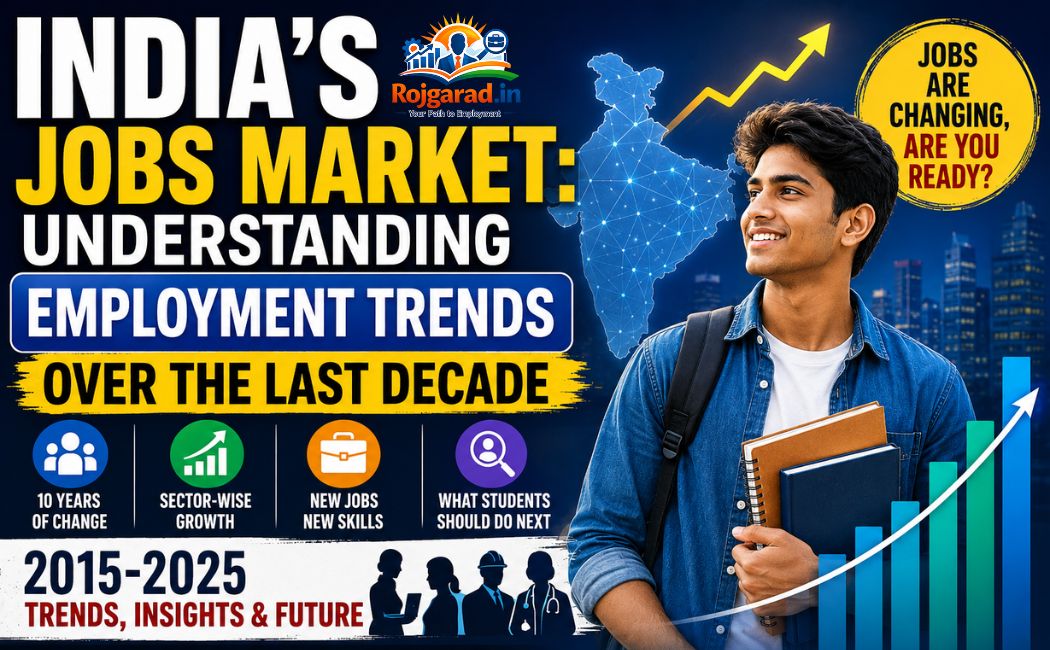
India’s employment landscape has undergone significant transformation over the last ten years. The country has experienced rapid economic expansion, digital transformation, startup growth, global economic disruptions, and technological advancements that have collectively reshaped the nature of work. While traditional employment sectors continue to play an important role, emerging industries such as information technology, e-commerce, fintech, artificial intelligence, renewable energy, and healthcare have created new opportunities for millions of workers. At the same time, challenges such as skill gaps, youth unemployment, automation, and changing employer expectations have influenced the job market. Understanding these employment trends is essential for students, graduates, and job seekers who want to build successful careers in a rapidly evolving economy.
Key Highlights at a Glance
| Particulars | Details |
|---|---|
| Topic | India’s Jobs Market Trends |
| Period Covered | 2015–2025 |
| Major Drivers | Digitalization, Startups, Technology |
| Fastest Growing Sectors | IT, Healthcare, FinTech, E-commerce |
| Key Challenge | Skills Gap |
| Emerging Opportunities | AI, Data Analytics, Green Jobs |
| Major Workforce Segment | Youth Population |
| Future Outlook | Positive but Skill-Driven |
How India’s Job Market Has Changed
A decade ago, India’s employment market was largely dependent on agriculture, manufacturing, construction, government jobs, and traditional service sectors. For many students, securing a government job was considered the ultimate career goal due to job security and stable income. However, economic reforms, increased internet penetration, smartphone adoption, startup investments, and globalization gradually shifted employment opportunities toward the digital economy. The rise of online platforms, remote work, and technology-based businesses created new job categories that barely existed ten years ago. As industries evolved, employers began prioritizing skills and adaptability alongside academic qualifications.
Employment Trends Over the Last Decade
One of the most noticeable trends has been the shift from traditional employment to technology-enabled jobs. India’s IT and digital services sectors expanded significantly, creating opportunities in software development, cybersecurity, cloud computing, digital marketing, content management, and business analytics. Simultaneously, startups generated employment across multiple sectors, including education technology, financial technology, logistics, healthcare, and e-commerce. This transformation accelerated demand for professionals with technical expertise, problem-solving abilities, and digital literacy. While traditional industries continued to employ large numbers of workers, growth rates were often slower compared to technology-driven sectors.
Employment Growth Across Major Sectors
| Sector | Growth Trend (2015-2025) | Employment Outlook |
| Information Technology | Very High | Strong |
| Healthcare | High | Expanding |
| E-commerce | High | Growing |
| FinTech | High | Growing |
| Manufacturing | Moderate | Stable |
| Agriculture | Slow | Transitioning |
| Education Technology | High | Expanding |
| Renewable Energy | High | Emerging |
| Construction | Moderate | Stable |
Impact of Digital Transformation
Digital transformation has arguably been the biggest force shaping India’s job market over the past decade. Affordable internet access and widespread smartphone usage enabled businesses to digitize operations and reach consumers online. As companies adopted cloud computing, automation, artificial intelligence, and data-driven decision-making, demand increased for employees capable of working with modern technologies. Digital transformation also created opportunities for freelancers, remote workers, content creators, online educators, and digital entrepreneurs. Many professionals who previously depended on local employment opportunities gained access to national and global markets through online platforms.
The COVID-19 Effect on Employment
The COVID-19 pandemic represented one of the most significant disruptions to India’s labor market. During the initial phase, millions of workers faced layoffs, salary reductions, and uncertainty. Sectors such as hospitality, tourism, aviation, and retail experienced severe setbacks. However, the crisis also accelerated digital adoption, remote work, e-commerce growth, telemedicine, and online education. Companies that adapted quickly created new employment opportunities, particularly in technology, logistics, healthcare, and digital services. The pandemic highlighted the importance of adaptability and demonstrated how quickly labor market conditions can change.
Rise of the Gig Economy
Another major trend over the last decade has been the growth of the gig economy. Ride-sharing platforms, food delivery services, freelance marketplaces, and online work platforms have enabled millions of Indians to earn income through flexible work arrangements. While gig work offers flexibility and accessibility, it also raises concerns about job security, benefits, and long-term career growth. Nevertheless, the gig economy has become an important component of India’s employment ecosystem, particularly for young workers seeking supplementary income or flexible work opportunities.
Current Employment Landscape
As of 2025-26, India’s job market continues to show resilience despite global economic uncertainties. Hiring activity remains strong in sectors such as information technology services, healthcare, renewable energy, financial services, artificial intelligence, semiconductor manufacturing, and digital commerce. Companies are increasingly focusing on skill-based hiring rather than relying exclusively on academic degrees. Employers are looking for candidates who can demonstrate practical abilities, industry knowledge, and adaptability. This shift is creating opportunities for students who invest in certifications, internships, and project-based learning.
Detailed Analysis: Why These Changes Happened
Several factors contributed to the transformation of India’s employment market. Government initiatives promoting digital infrastructure, startup ecosystems, manufacturing growth, and entrepreneurship encouraged job creation in emerging sectors. Foreign investments increased opportunities in technology and industrial sectors. Rapid technological advancements changed the skills employers needed. Consumer behavior shifted toward digital services and online commerce. Educational institutions began incorporating technology-focused courses, while private training providers expanded access to skill development programs. Together, these developments created a more dynamic and competitive employment environment.
Previous Year Trend Analysis
Employment Trend Comparison
| Year | Major Trend |
| 2015 | Traditional sector dominance |
| 2016 | Startup ecosystem expansion |
| 2017 | Increased digital adoption |
| 2018 | Growth in e-commerce hiring |
| 2019 | Expansion of FinTech sector |
| 2020 | Pandemic-related disruptions |
| 2021 | Recovery through digital jobs |
| 2022 | Hybrid work model adoption |
| 2023 | AI and automation discussions |
| 2024 | Skill-based hiring acceleration |
| 2025 | Human-AI collaboration growth |
Over the years, employment trends have gradually shifted from conventional job structures toward more flexible, technology-driven opportunities. Earlier, stable employment was primarily associated with government positions and large corporations. Today, startups, digital businesses, and specialized skill-based roles are equally attractive career options. The demand for workers who can continuously learn and adapt has increased significantly.
Who Is Most Affected by These Changes?
Students, fresh graduates, mid-career professionals, and low-skilled workers have been affected in different ways. Graduates entering the workforce face greater competition but also benefit from a wider range of career options. Professionals in traditional industries often need to upgrade their skills to remain competitive. Workers performing repetitive tasks face increasing automation risks, while individuals with analytical, technical, and creative skills generally enjoy stronger employment prospects. Educational institutions also face pressure to align curricula with industry requirements.
Expected Impact on Students and Job Seekers
The evolving job market presents both opportunities and challenges. Students who develop relevant skills can access careers that did not exist a decade ago. However, those who rely solely on academic degrees without acquiring practical experience may struggle to meet employer expectations. The importance of internships, certifications, project work, and continuous learning has increased considerably. Career planning now requires a stronger focus on industry trends and emerging technologies.
Expert Opinion
Labor market experts generally agree that India’s long-term employment outlook remains positive due to its large young population, growing economy, expanding digital infrastructure, and increasing global integration. However, experts also emphasize that future employment growth will be closely tied to skill development. The biggest challenge is not necessarily a shortage of jobs but a mismatch between available skills and employer requirements. Professionals who combine technical knowledge with communication, problem-solving, and adaptability are expected to enjoy the strongest career prospects.
Student Guidance
Students should focus on building practical skills alongside academic qualifications. Learning digital tools, communication techniques, data analysis, project management, and emerging technologies can significantly improve employability. Participation in internships, workshops, hackathons, and industry projects helps bridge the gap between education and employment. Students should also develop strong networking habits and maintain professional online profiles to increase visibility among potential employers.
What Students Should Do Now
Students should begin identifying industries with strong future growth potential and align their learning accordingly. Acquiring certifications in areas such as artificial intelligence, cloud computing, cybersecurity, digital marketing, business analytics, and financial technology can provide a competitive advantage. Building a portfolio of projects and practical achievements is increasingly important because employers often evaluate demonstrated skills rather than academic scores alone. Continuous learning should become a long-term habit rather than a short-term strategy.
Emerging Career Opportunities
Several sectors are expected to generate substantial employment opportunities in the coming years. These include artificial intelligence, machine learning, renewable energy, electric vehicles, semiconductor manufacturing, healthcare technology, cybersecurity, fintech, digital education, logistics technology, and sustainable development. Students who prepare for these sectors early may benefit from strong career growth and higher earning potential.
Important Dates and Milestones in India’s Employment Journey
| Year | Key Development |
| 2015 | Rapid startup ecosystem growth |
| 2016 | Increased digital payments adoption |
| 2017 | Expansion of digital infrastructure |
| 2018 | E-commerce hiring surge |
| 2020 | COVID-19 employment disruption |
| 2021 | Remote work normalization |
| 2022 | Hybrid workplace expansion |
| 2023 | AI integration discussions intensify |
| 2024 | Skill-first hiring trends grow |
| 2025 | Human-AI collaboration becomes mainstream |
Expected Next Update
Future employment reports are expected to focus increasingly on artificial intelligence adoption, workforce reskilling, green economy jobs, semiconductor manufacturing expansion, and the impact of automation on productivity. Policymakers, educational institutions, and employers will likely continue emphasizing skill development programs aimed at improving employability among young job seekers. Employment data over the next few years will provide clearer insights into how technology and economic growth continue to influence workforce demand.
Looking Ahead
India’s job market is not the same as it was ten years ago, and it is unlikely to remain the same over the next ten years. The most important lesson from the past decade is that adaptability has become one of the most valuable career assets. While technological change has disrupted some occupations, it has also created entirely new opportunities. Students who remain informed about industry trends, continuously upgrade their skills, and embrace lifelong learning will be better positioned to succeed in a competitive employment landscape. The future of work in India will not be defined solely by economic growth or technological innovation, but by how effectively individuals prepare themselves for change.
FAQs
1. What has been the biggest employment trend in India over the last decade?
The biggest trend has been the rapid growth of digital and technology-driven employment opportunities.
2. Which sectors have created the most jobs recently?
Information technology, healthcare, e-commerce, fintech, and digital services have generated significant employment opportunities.
3. Has automation reduced job opportunities?
Automation has changed certain job roles, but it has also created new opportunities in technology, data management, and AI-related fields.
4. Why are employers focusing more on skills today?
Companies increasingly value practical abilities because industry requirements change rapidly and many jobs require specialized competencies.
5. What role has the startup ecosystem played?
Startups have contributed significantly to job creation, innovation, and entrepreneurship across multiple sectors.
6. How did COVID-19 affect India’s job market?
The pandemic caused temporary disruptions but also accelerated digital adoption and remote work opportunities.
7. Which skills are most in demand?
Digital literacy, communication, data analysis, problem-solving, AI awareness, and technical skills remain highly valued.
8. Are government jobs still important?
Yes, government jobs remain attractive, but private-sector and technology-based opportunities have expanded considerably.
9. What should students prioritize in college?
Students should focus on internships, certifications, practical projects, networking, and skill development.