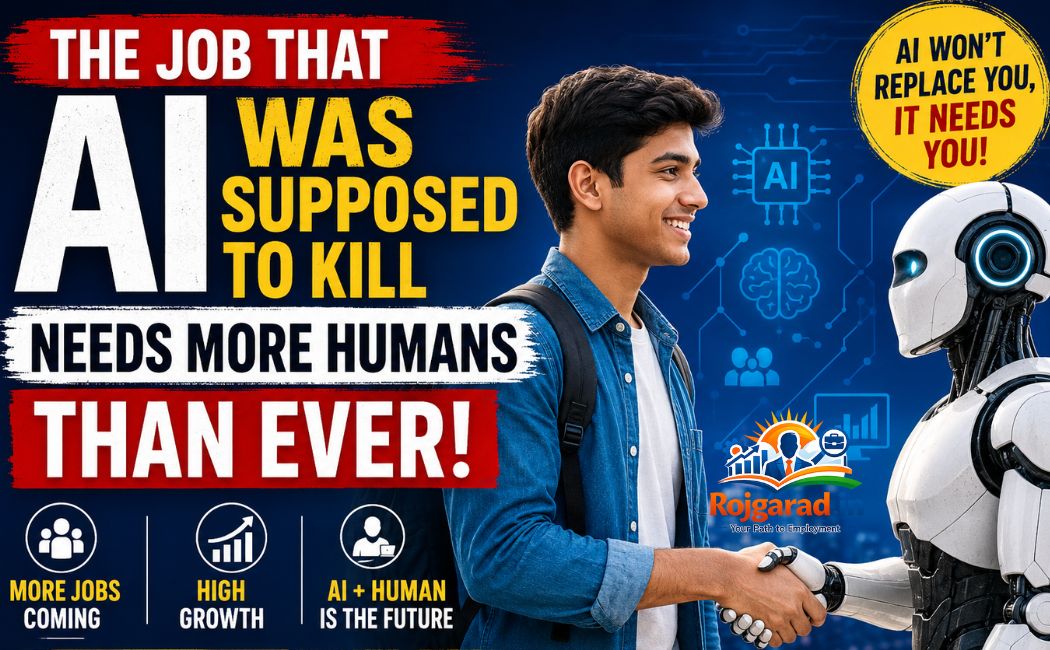
Artificial Intelligence (AI) has become one of the most discussed technologies of the decade. From content creation and coding to customer support and data analysis, AI tools are changing how people work. For years, experts predicted that many jobs would disappear because machines would take over routine tasks. However, a surprising trend has emerged across industries. One of the jobs that AI was expected to eliminate is now creating more opportunities for human workers than ever before. Rather than replacing people completely, AI is increasing the demand for skilled professionals who can supervise, improve, manage, and collaborate with intelligent systems. This shift is creating new career opportunities for students, graduates, and working professionals who understand both technology and human problem-solving skills.
Overview
| Particulars | Details |
|---|---|
| Article Topic | The Job That AI Was Supposed to Kill Needs More Humans Than Ever |
| Category | Career Guidance |
| Target Audience | Students, Graduates, Job Seekers |
| Industry Focus | AI, Technology, Content, Customer Support, Data Operations |
| Current Trend | Human-AI Collaboration |
| Skills Required | Communication, Critical Thinking, Digital Literacy |
| Future Scope | High Growth |
| Career Stability | Strong |
| Learning Difficulty | Moderate |
| Long-Term Potential | Excellent |
Understanding the Prediction That AI Would Replace Human Workers
When advanced AI systems started producing text, images, videos, and software code, many people assumed that millions of jobs would disappear within a few years. Reports from consulting firms, technology companies, and economists suggested that automation would reduce the need for human labor in various sectors. Content writers feared losing projects, customer service agents worried about chatbots, and even programmers wondered whether AI could eventually replace them. While automation has certainly changed workflows, the real-world outcome has been much more complex. Organizations quickly discovered that AI performs best when guided, monitored, and corrected by human professionals who understand context, ethics, customer expectations, and business goals.
The Job AI Was Expected to Kill
One of the clearest examples is content creation and information management. Many believed that AI-generated articles, reports, marketing materials, educational content, and customer communications would eliminate the need for human writers and editors. Instead, companies are hiring more people to review AI-generated content, verify facts, improve readability, ensure compliance, optimize SEO performance, and maintain brand voice. Businesses learned that while AI can produce content quickly, it often lacks judgment, accuracy, emotional intelligence, and deep understanding of audience needs. As a result, human expertise has become even more valuable.
Why Human Workers Are Still Essential
AI can generate answers within seconds, but it does not truly understand human emotions, cultural differences, business objectives, or social consequences in the same way people do. Human workers can identify errors, interpret complex situations, make ethical decisions, and communicate with empathy. These abilities remain difficult for machines to replicate. Organizations increasingly recognize that technology alone cannot guarantee quality outcomes. The combination of AI efficiency and human oversight produces better results than either working independently.
How AI Is Creating New Human Jobs
Instead of removing jobs completely, AI is generating entirely new categories of employment. Companies now recruit AI trainers, prompt engineers, AI content editors, machine learning auditors, data quality specialists, AI ethics consultants, automation managers, and digital transformation coordinators. These positions barely existed a few years ago. As businesses adopt AI tools, they need professionals who understand how to use them responsibly and effectively. This growing demand demonstrates that technological innovation often changes jobs rather than eliminating them.
Comparison Of AI Alone vs Human-AI Collaboration
| Factor | AI Alone | Human-AI Collaboration |
|---|---|---|
| Speed | Very High | High |
| Accuracy | Moderate | High |
| Creativity | Limited Context | Strong |
| Emotional Understanding | Very Low | Excellent |
| Decision Making | Rule-Based | Strategic |
| Error Detection | Inconsistent | Reliable |
| Customer Trust | Moderate | High |
| Long-Term Value | Limited | Excellent |
Eligibility to Build a Career in Human-AI Collaboration
Students often assume that only engineers can benefit from AI-related opportunities, but that is no longer true. Individuals from arts, commerce, science, management, journalism, education, law, and healthcare backgrounds can all participate in AI-driven careers. Basic computer literacy, communication skills, problem-solving ability, and willingness to learn new technologies are usually sufficient to begin. Employers increasingly value adaptability and learning potential more than traditional qualifications alone.
Educational Requirements
The educational requirements vary depending on the role. Some positions require a degree in computer science or engineering, while others accept graduates from any discipline. Content quality specialists, AI reviewers, customer experience managers, and digital marketing professionals often enter the field without advanced technical backgrounds. Short-term certifications in AI tools, data analysis, and digital communication can significantly improve employability.
Important Dates for Students Planning an AI-Related Career
| Stage | Recommended Timeline |
|---|---|
| Learn Basic AI Tools | During School or College |
| Complete Certification | Within 3-6 Months |
| Build Portfolio | 1-2 Months |
| Apply for Internships | Throughout the Year |
| Gain Practical Experience | 6-12 Months |
| Secure Full-Time Role | After Skill Development |
Benefits of Working in Human-AI Related Careers
The growth of AI-supported industries provides several advantages for young professionals. These careers often offer higher salaries compared to traditional entry-level jobs, opportunities for remote work, global employment prospects, faster career progression, and continuous learning opportunities. Since AI adoption is expanding across sectors, professionals with relevant skills can find opportunities in education, healthcare, finance, media, retail, manufacturing, and government services. The versatility of these skills increases career security even during economic changes.
Step-by-Step Process to Enter This Career Field
Step 1: Understand AI Fundamentals
Begin by learning what AI can and cannot do. Understanding machine learning, automation, chatbots, generative AI, and large language models helps students develop realistic expectations about technology and its applications.
Step 2: Develop Digital Skills
Students should become comfortable using productivity software, research tools, collaboration platforms, and AI applications. Practical experience matters more than theoretical knowledge in many entry-level positions.
Step 3: Improve Communication Skills
Strong writing, speaking, and critical thinking abilities are essential because human workers often act as the bridge between AI systems and end users. Effective communication remains one of the most valuable skills in the digital economy.
Step 4: Learn AI-Assisted Workflows
Rather than competing with AI, students should learn how to use it efficiently. Understanding prompt creation, output evaluation, content verification, and workflow optimization increases productivity and employability.
Step 5: Build a Portfolio
Employers want proof of skills. Students should create sample projects, case studies, articles, presentations, or AI-assisted work examples that demonstrate their ability to combine human judgment with technological tools.
Step 6: Apply for Internships
Internships provide practical exposure and help students understand industry expectations. Even short-term internships can significantly improve job prospects.
Step 7: Continue Learning
AI technology evolves rapidly. Continuous learning through courses, workshops, and professional certifications helps workers remain competitive in the job market.
Student Advice
Students should avoid the common mistake of viewing AI as a threat. Instead, they should see it as a powerful tool that can increase productivity and create opportunities. Those who learn to work alongside AI will likely enjoy better career prospects than those who ignore technological changes. Focus on building communication skills, analytical thinking, creativity, adaptability, and problem-solving abilities because these strengths complement AI rather than compete with it. Students should also develop a habit of fact-checking information and understanding ethical considerations when using automated systems.
Career Impact of AI-Human Collaboration
The impact on careers is significant. Professionals who understand both technology and human needs are becoming increasingly valuable. Companies no longer seek workers who simply complete repetitive tasks. Instead, they want employees who can manage information, interpret results, solve complex problems, and make strategic decisions. This shift rewards individuals who continuously upgrade their skills and embrace innovation. Career growth opportunities are expanding in fields such as digital marketing, content management, education technology, healthcare administration, business analytics, and customer experience management.
Industries Creating More Human Jobs Because of AI
Education Sector
Educational institutions use AI for personalized learning, assessment support, and administrative tasks. However, teachers, trainers, curriculum developers, and academic counselors remain essential because students require mentorship, motivation, and human interaction that technology cannot fully provide.
Healthcare Industry
Healthcare organizations use AI for diagnostics, record management, and research support. Yet doctors, nurses, healthcare administrators, and patient coordinators continue to play critical roles because patient care depends heavily on empathy, communication, and ethical judgment.
Content and Media Industry
Content creation has experienced dramatic changes due to AI tools. However, demand for editors, content strategists, fact-checkers, SEO specialists, and media managers continues to grow because quality assurance and audience engagement require human expertise.
Customer Service Sector
Many businesses introduced chatbots to reduce customer support costs. Surprisingly, customer service teams remain essential because complex issues often require emotional intelligence, negotiation skills, and personalized assistance that automated systems struggle to provide.
Software Development
AI can generate code snippets and automate certain programming tasks, but software engineers remain in high demand. Human developers are needed to design systems, solve complex problems, maintain security, and understand business requirements.
Common Mistakes Students Make
Many students either underestimate AI or overestimate its capabilities. Some believe AI will replace every profession and therefore avoid certain career paths. Others assume learning a few AI tools guarantees immediate success. Both perspectives are inaccurate. Another common mistake is focusing only on technical skills while ignoring communication, teamwork, leadership, and critical thinking. Employers increasingly value professionals who combine technical knowledge with strong interpersonal abilities. Students should also avoid relying entirely on AI-generated work without understanding the underlying concepts.
Expert Tips for Long-Term Success
Focus on Human Skills
Communication, creativity, leadership, emotional intelligence, and decision-making skills are becoming more valuable as automation increases. These capabilities help professionals stand out in competitive markets.
Learn Multiple AI Tools
Different industries use different platforms. Familiarity with various AI applications improves flexibility and adaptability in changing work environments.
Build Industry Knowledge
Technology skills alone are not enough. Understanding industry-specific challenges helps professionals use AI more effectively and deliver greater value.
Create a Personal Brand
Students should build professional profiles, portfolios, blogs, and LinkedIn presence to showcase their expertise and attract opportunities.
Stay Updated
AI evolves quickly. Reading industry reports, attending webinars, and participating in online communities helps professionals remain informed about emerging trends.
Comparison Of Traditional Worker vs AI-Enhanced Professional
| Skill Area | Traditional Worker | AI-Enhanced Professional |
|---|---|---|
| Productivity | Moderate | High |
| Research Speed | Average | Fast |
| Data Analysis | Manual | Assisted |
| Career Growth | Steady | Faster |
| Adaptability | Moderate | High |
| Industry Demand | Stable | Growing |
| Salary Potential | Average | Above Average |
| Future Readiness | Moderate | Excellent |
Future Opportunities in the AI Era
The future job market will likely reward professionals who can effectively collaborate with intelligent technologies. New roles are emerging in AI governance, digital education, human-machine interaction, data quality management, cybersecurity, content strategy, healthcare technology, and automation consulting. As organizations continue adopting AI systems, demand for skilled human oversight will increase rather than disappear. Students entering the workforce today have an opportunity to position themselves at the center of this transformation.
Emerging Career Roles
Some of the fastest-growing opportunities include AI Operations Specialist, Prompt Engineer, AI Content Editor, Digital Learning Consultant, Human-AI Workflow Manager, AI Ethics Advisor, Data Annotation Expert, Customer Experience Strategist, Automation Coordinator, and AI Training Specialist. These careers demonstrate how technology creates new forms of employment even as it changes existing ones.
How Students Can Prepare During College
College students should focus on practical learning rather than memorizing theory alone. Participating in projects, internships, online certifications, hackathons, research activities, and collaborative assignments helps develop real-world skills. Learning basic data analysis, digital communication, AI applications, and project management can significantly improve employability. Students should also cultivate curiosity because lifelong learning will become increasingly important in an AI-driven economy.
The Reality Behind the AI Replacement Fear
Throughout history, technological advancements have often generated fears about job losses. Similar concerns emerged during the Industrial Revolution, the rise of computers, and the expansion of the internet. While certain tasks became automated, entirely new industries and professions emerged. AI appears to be following a similar pattern. The nature of work is changing, but human contribution remains essential. Workers who adapt and learn new skills generally benefit from technological progress rather than becoming victims of it.
FAQs
1. Will AI completely replace human jobs?
No. AI will automate some tasks, but most industries still require human judgment, creativity, and communication skills.
2. Which jobs are growing because of AI?
AI content editing, prompt engineering, AI training, data quality management, digital marketing, and AI operations roles are growing rapidly.
3. Can non-technical students work in AI-related careers?
Yes. Students from arts, commerce, science, and other backgrounds can build careers that involve AI-assisted work.
4. What skills are most important in the AI era?
Communication, critical thinking, creativity, adaptability, and digital literacy are among the most valuable skills.
5. Is coding necessary for AI careers?
Not always. Many AI-related roles focus on content, management, strategy, customer experience, and quality assurance.
6. How can students start learning AI?
Students can begin with free online resources, certifications, tutorials, and practical projects using AI tools.
7. Are AI-related jobs well paid?
Many AI-supported careers offer competitive salaries because demand for skilled professionals is increasing.