
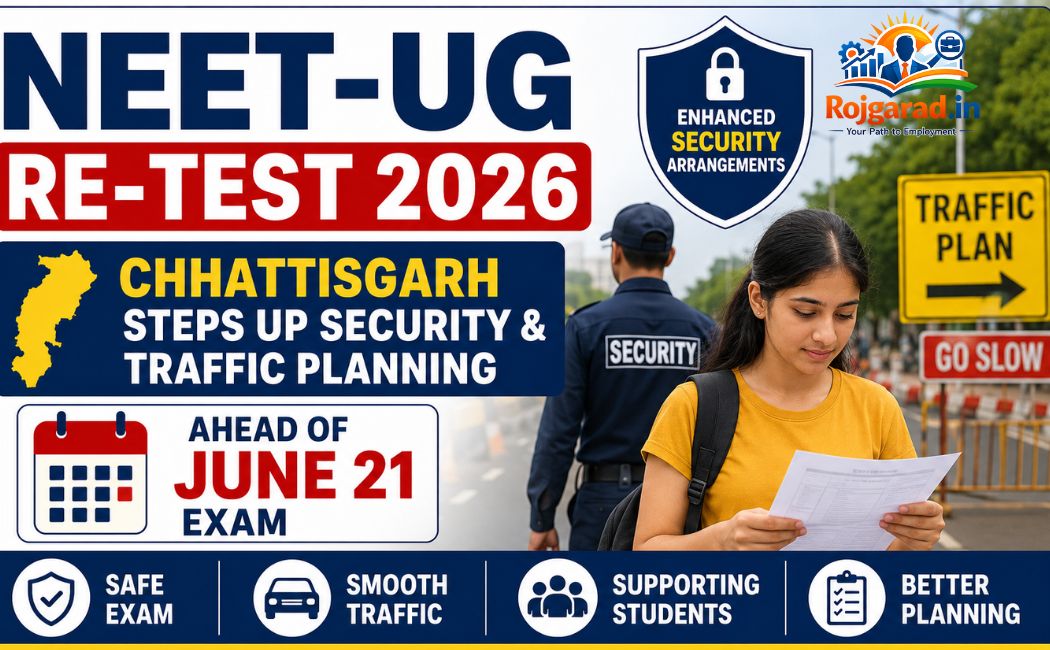
The upcoming NEET-UG re-test scheduled for June 21 has become a major focus for students, parents, educational institutions, and state authorities in Chhattisgarh. While examination security has always been an important aspect of large-scale competitive tests, the re-test has placed additional responsibility on administrators to ensure a smooth, transparent, and disruption-free process. In response, authorities have intensified security arrangements, strengthened coordination among departments, and introduced detailed traffic management plans around examination centers.
The decision to enhance security measures is not merely an administrative exercise. It reflects broader concerns regarding examination integrity, candidate safety, transportation logistics, and public confidence in one of India’s most competitive entrance examinations. For thousands of medical aspirants appearing in the re-test, these preparations are expected to play a crucial role in reducing uncertainty and ensuring that the examination process proceeds fairly. As the June 21 examination date approaches, students are increasingly interested in understanding why additional arrangements are being made, how they may be affected, and what practical steps they should take to avoid last-minute difficulties.
NEET-UG Re-Test 2026 Highlights
| Particulars | Details |
|---|---|
| Examination | NEET-UG Re-Test 2026 |
| Examination Date | June 21, 2026 |
| State Focus | Chhattisgarh |
| Key Administrative Measures | Enhanced Security and Traffic Planning |
| Candidate Category | Eligible Re-Test Candidates |
| Examination Mode | Offline (Pen and Paper) |
| Conducting Authority | National Testing Framework Authorities |
| Local Support Agencies | Police, Transport and District Administration |
| Main Objective | Secure and Smooth Examination Conduct |
| Student Priority | Timely Arrival and Fair Examination Environment |
What Happened?
Authorities in Chhattisgarh have announced extensive security and traffic management arrangements ahead of the NEET-UG re-test. The move comes as officials seek to ensure that candidates can reach examination centers without delays and complete the examination under secure conditions. Multiple departments have reportedly been instructed to coordinate logistics, monitor examination zones, manage vehicle movement, and strengthen surveillance around sensitive locations. Unlike a routine examination day, a re-test often attracts greater scrutiny because stakeholders expect a highly transparent process. Consequently, administrative preparedness becomes a key factor in maintaining confidence among candidates and parents.
Why Additional Security Measures Are Being Implemented
Large national entrance examinations involve thousands of candidates, multiple examination centers, and strict procedural requirements. Any disruption—whether related to transportation, unauthorized activities, crowd management, or logistical failures—can affect candidate experience and examination credibility. Enhanced security measures are therefore intended to prevent unauthorized access to examination centers, improve monitoring of examination activities, streamline candidate movement, and minimize the risk of disturbances. Authorities are also focusing on ensuring that examination materials are handled securely and that candidates experience a controlled and well-organized testing environment. The emphasis on security is particularly important because competitive entrance examinations influence admission opportunities for students seeking careers in medicine and healthcare.
Latest Update on Chhattisgarh’s Preparations
Recent developments indicate that local administrative units, police authorities, and traffic departments have been directed to coordinate closely in the days leading up to the examination. Traffic management plans are expected to focus on examination center routes, congestion-prone areas, and high-density urban locations where candidate movement could be affected.
Officials are also expected to monitor examination centers more closely than during ordinary public examinations. Such measures aim to reduce operational risks and improve overall efficiency on examination day. For students, these preparations signal that authorities are prioritizing examination stability and candidate convenience.
Background: Why a NEET-UG Re-Test Matters
NEET-UG serves as the primary gateway for admission to undergraduate medical education across India. Every year, lakhs of students compete for a limited number of medical and dental seats. Given the high stakes involved, any examination-related issue can have significant consequences for candidates. Re-tests are typically conducted when authorities determine that certain candidates require an additional opportunity under specific circumstances. Such examinations naturally attract public attention because they involve fairness, transparency, and equal opportunity concerns. The June 21 re-test therefore carries importance not only for participating candidates but also for the broader medical admission ecosystem.
Understanding the Scale of NEET-UG Examinations
| Parameter | General Observation |
|---|---|
| Candidate Participation | Very High |
| Examination Centers | Multiple Locations |
| Competition Level | Extremely High |
| Admission Stakes | Medical and Dental Seats |
| Security Requirement | Critical |
| Traffic Management Need | Significant in Urban Areas |
Detailed Analysis: Security Planning Beyond Examination Halls
Many students assume that examination security begins and ends at the examination center gate. In reality, security planning starts much earlier and involves multiple layers of coordination. Authorities must oversee transportation routes, examination material handling, center access control, crowd management, emergency response readiness, and communication systems. In a re-test environment, these measures become even more important because stakeholders closely monitor the examination process. Enhanced preparedness helps reduce uncertainty and minimizes the possibility of operational disruptions. Experts note that visible security arrangements can also improve candidate confidence by creating a more structured examination atmosphere.
Traffic Planning and Why It Matters for Students
Traffic management is often overlooked when discussing examination preparation, yet it can significantly influence candidate performance. Delays caused by congestion, road diversions, public gatherings, or transportation disruptions can increase stress levels before the examination begins. By identifying critical routes and implementing traffic control measures, authorities aim to reduce travel-related difficulties. This is particularly important in urban centers where examination-related traffic can create temporary bottlenecks. For candidates, improved traffic planning translates into more predictable travel times and reduced anxiety on examination day.
Who Is Most Affected by These Arrangements?
The primary beneficiaries are candidates appearing for the re-test. Improved traffic management can help students arrive on time, while enhanced security contributes to a fairer examination environment. Parents also benefit because clearer administrative planning reduces uncertainty regarding transportation and examination logistics. Educational institutions hosting examination centers may experience smoother operations due to coordinated support from local authorities. Even residents living near examination centers can be affected, as temporary traffic diversions or restrictions may be introduced to facilitate examination-related movement.
Comparison with Regular Examination Arrangements
| Aspect | Regular Examination | Re-Test Examination |
|---|---|---|
| Public Attention | Moderate | High |
| Security Monitoring | Standard | Enhanced |
| Traffic Planning | Routine | Intensive |
| Administrative Coordination | Normal | Expanded |
| Candidate Scrutiny | Limited | Greater |
| Media Interest | Moderate | High |
Previous Year Comparison
Past examination cycles have demonstrated the growing importance of logistical planning in national entrance examinations. Over the years, authorities have increasingly focused on surveillance systems, candidate verification procedures, transportation planning, and center management practices. The current preparations in Chhattisgarh reflect broader trends observed across India, where examination administration has become more technology-driven and security-conscious. While examination formats may remain similar, operational management has evolved significantly to address emerging challenges.
Previous Year Trend Analysis
One notable trend in recent years has been the increasing integration of district administration, law enforcement agencies, and transport departments into examination planning processes. Earlier, examination management was largely center-focused. Today, authorities recognize that candidate experience begins long before entry into the examination hall. Another trend is the growing emphasis on preventive planning. Rather than responding to problems after they occur, authorities now attempt to identify and address potential challenges in advance. This shift reflects a more comprehensive approach to examination governance.
Expected Impact on Candidates
The strengthened arrangements are expected to create a more organized examination environment. Candidates may benefit from reduced travel uncertainty, smoother entry procedures, improved security, and clearer communication regarding examination guidelines. A structured environment can also contribute indirectly to performance by reducing avoidable stress. Students who spend less energy worrying about transportation or logistical issues can focus more effectively on the examination itself. However, enhanced security may also require candidates to arrive earlier and comply strictly with examination protocols.
Expected Impact on Examination Administration
For administrators, the success of these measures could strengthen public confidence in examination management systems. Effective coordination among departments demonstrates institutional readiness and can help reduce complaints related to logistics and candidate experience. If implemented successfully, the arrangements may serve as a model for future large-scale examinations conducted within the state. The emphasis on preparation rather than reaction reflects a broader trend toward professionalized examination administration.
Expert Opinion
Education analysts generally support proactive security and traffic planning because it addresses challenges before they affect candidates. According to examination management experts, logistical disruptions can have a significant psychological impact on students, particularly in high-stakes tests such as NEET-UG. Experts also emphasize that candidates should not assume enhanced arrangements eliminate personal responsibility. Students must still verify examination center details, monitor travel plans, and comply with reporting requirements. Another common recommendation is to conduct a trial visit to the examination center area whenever feasible. Familiarity with the route can reduce uncertainty on examination day.
Student Guidance: How to Prepare for June 21
Candidates should begin preparing their examination-day strategy several days in advance. This includes confirming examination center details, checking travel routes, verifying reporting times, and organizing required documents. Students should avoid making last-minute transportation decisions. If possible, they should estimate travel time during similar traffic conditions and build additional buffer time into their plans. Equally important is maintaining academic focus. Administrative preparations are intended to support candidates, but examination success ultimately depends on preparation, revision, and time management.
Common Mistakes Students Should Avoid
Many candidates underestimate travel-related risks and leave for examination centers later than advisable. Others fail to verify reporting instructions, resulting in unnecessary stress. Another common mistake is relying entirely on digital devices for important information without maintaining printed backups of admit cards and identification documents. Students should also avoid spending excessive time discussing examination rumors online. Focusing on revision and official information sources remains a more productive strategy.
What Students Should Do Now
Candidates should immediately review their examination plans and identify any potential logistical concerns. Travel arrangements, required documents, reporting schedules, and emergency contact information should be finalized well before the examination date. Students should also monitor official communications regarding examination instructions and local administrative advisories. Preparing a checklist can help ensure that essential items are not forgotten. Most importantly, candidates should continue academic revision rather than becoming distracted by speculation surrounding examination administration.
Important Dates
| Event | Date/Status |
|---|---|
| NEET-UG Main Examination Cycle | Completed |
| Re-Test Notification | Issued |
| Admit Card Availability | As Per Schedule |
| NEET-UG Re-Test | June 21, 2026 |
| Evaluation Process | After Examination |
| Result-Related Updates | Expected Later |
| Counselling Preparations | Subsequent Phase |
Expected Next Update
The next major development is likely to involve final operational reviews by district authorities and examination administrators. Candidates can also expect reminders regarding reporting procedures, permitted items, and examination-day instructions. Following the examination, attention will shift toward evaluation timelines, result-related announcements, and counselling schedules. Further updates may also include assessments of examination conduct and administrative performance. For candidates, the period immediately before the examination remains the most important preparation window.
Why This Development Matters Beyond Chhattisgarh
The enhanced arrangements highlight an important shift in how major examinations are managed across India. Increasingly, authorities recognize that examination success depends not only on question papers and evaluation systems but also on transportation, security, communication, and candidate support mechanisms. The measures being implemented in Chhattisgarh illustrate how examination administration is evolving into a multi-agency responsibility. Such developments may influence planning approaches in other states during future examination cycles. This broader perspective is becoming increasingly relevant as national entrance examinations continue to grow in scale and complexity.
Conclusion
The decision by Chhattisgarh authorities to strengthen security and traffic planning ahead of the June 21 NEET-UG re-test represents a significant administrative effort aimed at ensuring a fair, secure, and well-organized examination environment. While the arrangements may appear logistical in nature, they directly affect candidate experience, examination integrity, and public confidence in the admission process.
For students, the key takeaway is clear: administrative preparations can support success, but personal preparation remains equally important. Candidates who finalize travel plans early, follow official instructions carefully, and maintain focus on revision are likely to benefit most from the enhanced arrangements. As the examination date approaches, preparedness—both institutional and individual—will remain the defining factor in ensuring a smooth and successful re-test experience.
FAQs
1. When is the NEET-UG re-test scheduled?
The re-test is scheduled for June 21, 2026.
2. Why has Chhattisgarh increased security measures?
Authorities aim to ensure a secure, transparent, and disruption-free examination process.
3. What role does traffic planning play?
Traffic planning helps candidates reach examination centers on time and reduces congestion-related delays.
4. Who benefits from these arrangements?
Candidates, parents, examination centers, and administrators all benefit from improved planning.
5. Should students arrive earlier than usual?
Yes, arriving early is advisable, especially when enhanced security procedures are in place.
6. Can traffic restrictions affect local residents?
Temporary traffic management measures may affect movement near examination centers.